
Something big just happened in AI.
Not another chatbot update.
Not another “AI will change everything” headline.
The OpenClaw moment feels different.
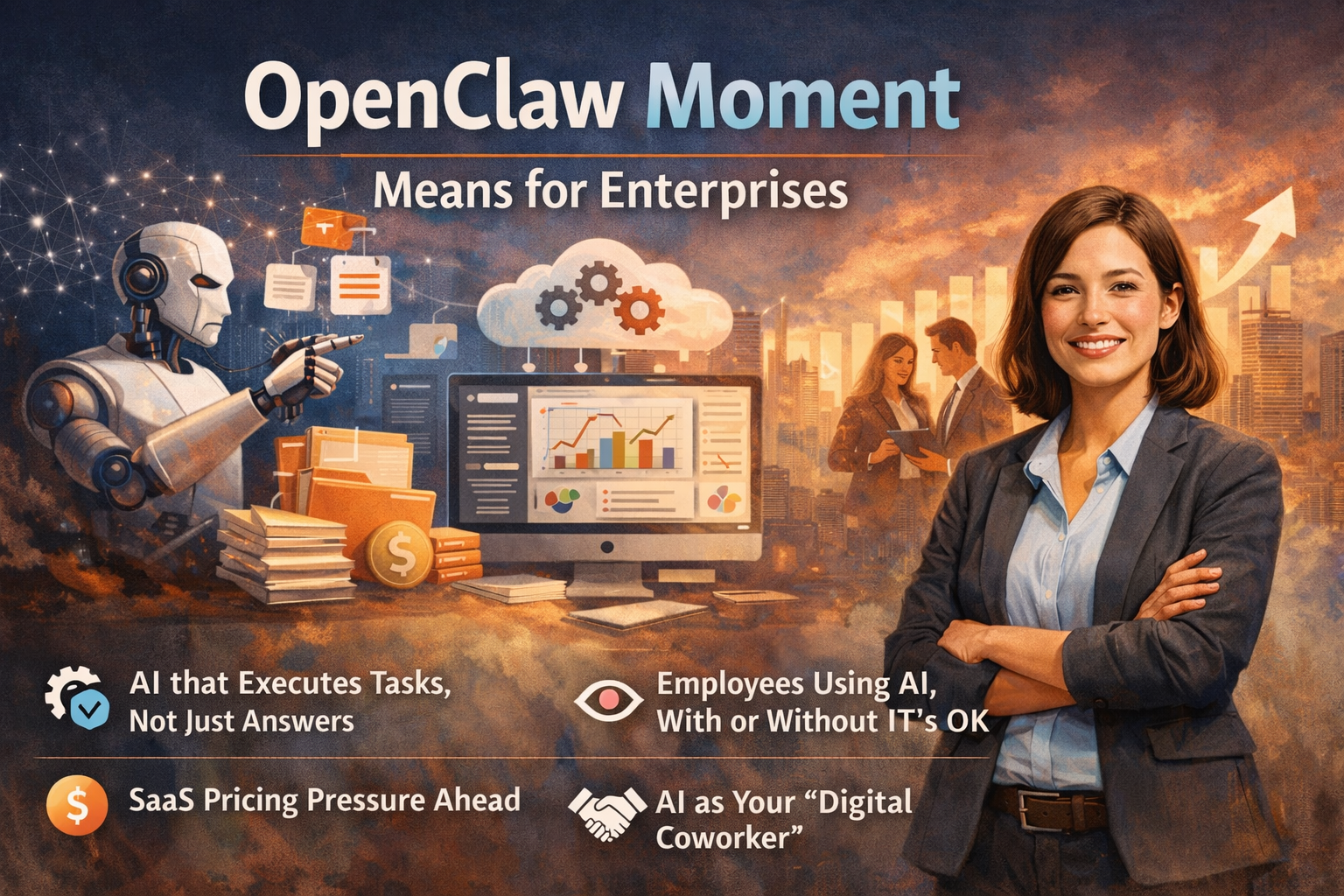
For the first time, autonomous AI agents aren’t just answering questions — they’re doing the work. Clicking through apps. Managing files. Executing multi-step tasks. Acting almost like a digital employee.
And for enterprises, that changes everything.
Here’s what actually matters.
1. AI Just Moved From “Assistant” to “Operator”
Until now, most enterprise AI tools were helpful… but passive.
They summarized. Suggested. Drafted.
OpenClaw-style agents don’t just suggest what to do — they actually do it.
That shift from assistant → operator is massive. It means AI can now handle workflows end-to-end, not just one small part of them.
For enterprises, this isn’t about productivity boosts.
It’s about redefining how work gets done.
2. Employees Are Already Using It (With or Without Permission)
Here’s the uncomfortable truth:
If your company hasn’t approved autonomous AI tools yet… your employees might already be using them.
When tools become powerful and easy, adoption doesn’t wait for policy.
This creates a new challenge for IT and security teams. AI agents accessing internal systems without visibility? That’s not just innovation — that’s risk.
Enterprises now have to balance speed with control.
3. SaaS Pricing Models May Not Survive This
Think about it.
If one AI agent can do the work of 10 licensed users inside a SaaS platform, why would companies keep paying per seat?
Autonomous agents are quietly challenging the foundation of traditional SaaS pricing.
This doesn’t mean SaaS is dead.
It means vendors will have to rethink how they price value in an AI-driven world.
And enterprises will start asking harder questions.
4. AI Is Becoming a “Digital Coworker”
This isn’t just automation anymore.
OpenClaw represents something closer to a digital teammate — an entity that can plan, execute, adapt, and even collaborate across tools.
We’re moving toward a world where teams don’t just use software — they supervise AI coworkers.
That changes hiring.
That changes training.
That changes management.
Enterprises need to start thinking in terms of human + AI teams.
5. Security Just Became More Complicated
Autonomous agents act with permissions.
They log in. Access files. Use credentials. Trigger APIs.
If those permissions aren’t controlled properly, the risks multiply fast.
This is where many companies could stumble. Not because the AI is malicious — but because governance wasn’t ready.
The OpenClaw moment isn’t just about innovation.
It’s about responsibility.
Then What Should Enterprises Do?
Don’t panic or Don’t ignore it either.
Here’s the balanced approach:
- Experiment in controlled environments
- Update security policies for AI agents
- Train teams on how to supervise AI workflows
- Rethink vendor contracts and SaaS usage
- Treat AI agents like digital employees — with defined roles and limits
The companies that adapt early will move faster.
The ones that resist will struggle to keep up.
Final Thought
The OpenClaw moment isn’t hype.
It’s a signal.
A signal that AI is no longer just a tool we talk to — it’s becoming something that works alongside us.
For enterprises, the question isn’t “Is this real?”
FAQ About OpenClaw in AI
1. What is the OpenClaw moment in AI?
The OpenClaw moment is basically a shift in how we think about AI. Until now, AI mostly helped us — writing drafts, answering questions, summarizing documents. But this new wave of AI can actually do the work. It can move between apps, complete tasks, and handle workflows on its own. That’s a big jump from “assistant” to something that feels more like a digital operator.
2. How is OpenClaw different from traditional AI tools?
Traditional AI tools respond to prompts. You ask, they answer. Simple.
OpenClaw-style AI agents go further. They don’t just respond — they act. They can log into tools, move data around, complete multi-step tasks, and finish processes without needing constant instructions. That’s what makes this moment different — AI isn’t just helping anymore, it’s executing.
3. Why does the OpenClaw moment matter for enterprises?
Because it changes how work actually gets done inside companies.
So rather employees manually switching between tools and systems, AI agents can handle boring workflows automatically. That can mean faster operations, fewer errors, and lower costs. But it also means enterprises need stronger governance and clearer boundaries around AI access.
It’s a massive opportunity — if handled correctly.
4. Autonomous AI agents are safe for enterprise?
They can be, but only with proper supervision.
These agents mostly need access to internal systems, data, and permissions. Without the right controls, that creates risk. With clear rules, monitoring, and defined roles, though, they can be just as secure as any other enterprise system. The key is treating them like digital employees — with limits and accountability.
5. Will AI agents replace human employees?
Not in the way people fear.
AI agents are great at repeated, structured tasks. Humans are still better at strategy, creativity, decision-making, and relationships. Human will start working with AI agents, not being replaced by them.
It’s less about elimination — and more about evolution.